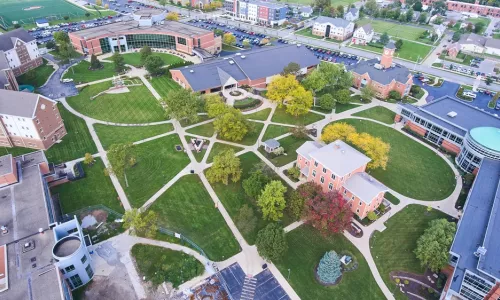
University of Chicago

A red light university has at least one policy that both clearly and substantially restricts freedom of speech. Read more here.

Public or Private: Private
Federal Circuit: Seventh Circuit
Head of Institution: President Robert J Zimmer
University of Chicago
President of the University
Administration Building
5801 South Ellis Avenue
Chicago, IL 60637
773-702-8001
rzimmer@uchicago.edu
Website: http://www.uchicago.edu

« Return to School Overview

Do you have any information, updates, or changes regarding the policies at this institution? Let us know!

On this page, FIRE has excerpted policies that address speech and expression. You may download the full policy in .pdf form, below.

Restrictions on Expressive Rights

Harassment Policies (Learn More)

Policy on Unlawful Discrimination and Harassment 09-10

Sexual harassment encompasses a
range of conduct, such as unwanted touching or persistent unwelcome comments, e-mails,
or pictures of an insulting or degrading sexual nature, which may constitute unlawful
harassment, depending upon the specific circumstances and context in which the conduct
occurs. For example, sexual advances, requests for sexual favors, or sexually-directed
remarks or behavior constitute sexual harassment when (i) submission to or rejection of
such conduct is made, explicitly or implicitly, a basis for an academic or employment
decision, or a term or condition of either; or (ii) such conduct directed against an individual
persists despite its rejection.
View full policy (PDF, 75 KB).

Student Manual: Student Life and Conduct- University House System Discipline 09-10

[R]esidents may not engage in personal abuse, written or oral, directed against other residents, guests, or members of the housing staff. Any form of abusive, threatening, or harassing behavior will be considered grounds for serious disciplinary action by the housing staff.
View full policy (PDF, 216 KB).

Policy on Unlawful Discrimination and Harassment 09-10

A person's subjective belief that behavior is offensive, intimidating or hostile does
not make that behavior unlawful harassment. The behavior must be objectively
unreasonable.
Unlawful harassment based on one of the factors listed above [race, color, religion,
sex, sexual orientation, gender identity, national or ethnic origin, age, disability, veteran
status, or other protected classes under the law] is verbal or physical conduct that is so severe or pervasive that it has the purpose or effect of unreasonably
interfering with an individual's work performance or educational program participation, or
that creates an intimidating, hostile, or offensive work or educational environment.
View full policy (PDF, 75 KB).

Free Speech Zones

Student Manual: Student Life and Conduct- Protest and Demonstrations Policy 09-10

Like all other events or activities at the University, a request to hold a protest or demonstration should be submitted no later than 48 hours before the start of the event and must be approved by ORCSA.
View full policy (PDF, 216 KB).

Posting Policies

Student Manual: Student Life and Conduct- Univerity House System Discipline 09-10

If a posting contains obscene language and/or pictures, or if a posting is deemed to be offensive to a particular group or individual, the posting may be removed.
View full policy (PDF, 216 KB).

Policies on Bias and Hate Speech

Diversity, Civility and Equity: Hate Crimes and Bias Incidents 09-10

Bias is a pre-formed negative opinion or attitude toward a group of persons who possess common characteristics, such as skin color, or cultural experiences, such as religion or national origin. Bias incidents involve actions committed against a person or property that are motivated, in whole or in part, by the bias against race, religion, sexual orientation, ethnicity, national origin, ancestry, gender, gender identity, age, or disability. ... The bias incidents that will be addressed by the Bias Response Team include actions that are motivated by bias but may not meet the necessary elements required to prove a crime.
According to the organization, Partners Against Hate, hate speech can consist of "bigoted and prejudiced language," spoken or written. It is often classified as a bias incident; however, if the language threatens violence or involves property damage, such as in the case with bias-motivated graffiti, hate crime laws may apply.
View full policy (PDF, 63 KB).

Diversity, Civility and Equity at the University of Chicago: Reporting Incidents 09-10

A student can make a report whether or not they want any action to be taken.
Examples of incidents: * A message on your whiteboard perceived as derogatory

* In a verbal exchange with your roommate over keeping the apartment clean, the roommate calls you different names ... * Remarks perceived as derogatory, made about you by a classmate or faculty member.
View full policy (PDF, 62 KB).

Advertised Commitments to Free Expression

Student Manual: Student Life and Conduct- Protest and Demonstrations Policy 09-10

The primary function of a university is to discover and disseminate knowledge by means of research and teaching. To fulfill this function, a free interchange of ideas is necessary not only within the university but also with the larger society. At the University of Chicago, freedom of expression is vital to our shared goal of the pursuit of knowledge.
View full policy (PDF, 216 KB).

NOTE: You must have Adobe Acrobat installed to view policies in PDF format.

The speech codes and policies above were last fully checked via internet and other research means by FIRE in May 2010. According to FIRE’s research the substantive policies are current at least until this date. Directory information, including the name of the president of the college or university, may have been updated more recently. If any policy has been revised, or if you believe that we are in error, please contact us.