Table of Contents
Anti-ICE protesters disrupted worship in a Minnesota church. Here’s why the First Amendment doesn’t protect their actions.
Shutterstock.com
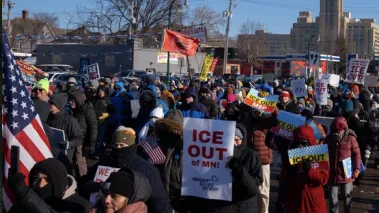
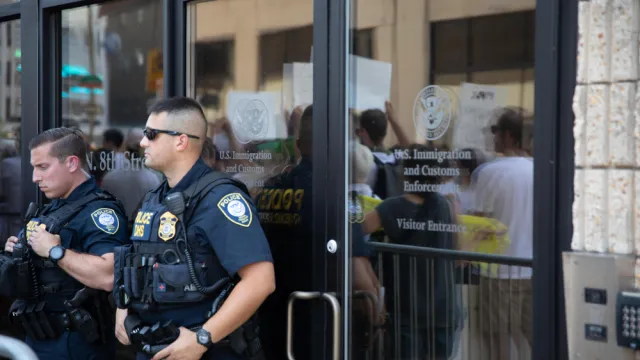
Anti-ICE protest in Minneapolis, Minnesota, on Dec. 20, 2025
Recent events in Minnesota — where anti-ICE protesters interrupted a service at Cities Church in St. Paul, targeted pastor David Easterwood (who is apparently also an ICE official), then defended the disruption as an exercise of First Amendment rights — reflect a growing confusion about what the Constitution does and does not protect. Similar incidents have occurred in recent years, affecting churches, synagogues, and other religious services across the country. Whatever one thinks of the protesters’ underlying cause, the constitutional question here is not a close one.
“This is what the First Amendment is about,” said journalist Don Lemon, who entered the church with the protesters and defended their actions to a pastor who was asking them to leave. Organizers Nekima Levy Armstrong and Chauntyll Louisa Allen have since been arrested for allegedly violating the FACE Act, which prohibits using force, threats, or physical obstruction to interfere with religious services.
There is no First Amendment right to enter a house of worship and engage in conduct that effectively shuts down a religious service, even as part of a protest. Nor does anybody have the right to remain on private property after being asked by its owner or authorized representatives to leave.
The First Amendment offers its strongest protection to speech in traditional public forums — streets, sidewalks, and parks — while also protecting freedom of association, religious exercise, and freedom of conscience. A society committed to free expression depends not only on protecting speech, but on maintaining a clear delineation between protected speech, on the one hand, and unprotected civil or criminal conduct on the other.
The First Amendment restrains government action, not private individuals or institutions. Courts have long distinguished between public spaces, including those that must remain open to expressive activity, and private spaces where those who control them retain the right to exclude unwanted speech. Private property owners are not required to open their spaces to expressive activity simply because the message is political or morally urgent.
Treating the First Amendment as a roaming permission slip for disruption misstates both the law and the logic of free expression.
A worship service held inside a church is not a public forum. It is a private religious gathering, typically held on private property, convened for a specific and constitutionally protected purpose: religious exercise.
This distinction matters because the First Amendment is often misunderstood as an affirmative license to protest anywhere. It is not. It protects individuals from government suppression of speech; it does not compel private institutions to host expression they do not invite. Treating the First Amendment as a roaming permission slip for disruption misstates both the law and the logic of free expression.
Religious liberty under the First Amendment includes more than the freedom to hold beliefs. It includes the right to gather in a house of worship without facing threats of violence or intrusive disruption from others. While houses of worship are not identical to homes or hospitals, worship services involve deeply personal practices — prayer, ritual, reflection — that the Constitution has long treated as deserving of solicitude.
Entering a house of worship or violating trespass or noise ordinances to interrupt services is not merely expressive conduct. It is also disruptive conduct that prevents others from exercising their rights. It interferes with religious exercise and compels an audience to listen and respond against its will. The First Amendment does not require that outcome. A free-speech culture depends on the right to gather with likeminded others in private spaces without outsiders hijacking the space for their own purposes, just as much as it depends on protection from censorship.
None of this diminishes the importance of protest. The First Amendment robustly protects the right to criticize religious institutions and oppose their teachings. Protesters may lawfully assemble on public sidewalks outside a church, distribute literature, chant, or hold signs, subject to the same content-neutral time, place, and manner restrictions that apply to all speakers. Those protections are strong, and they must remain strong.
What the First Amendment does not protect is the commandeering of a worship service or any other private event. That principle is viewpoint neutral. The constitutional analysis would be the same if protesters took over a mosque during prayer or a synagogue during Shabbat — or, for that matter, a university classroom during a lecture or a private theater during a performance. Indeed, many Americans intuitively recognize that such conduct would be unlawful in those contexts. That intuition is correct, and it applies regardless of ideology or religion. As constitutional lawyer David French recently observed in response to these events, interrupting a church service interferes with the rights of fellow citizens and calls for the protection of peaceful worship. That observation reflects settled constitutional doctrine rather than partisan preference.
Speech is not a crime — even if it complicates ICE’s job
Aaron Terr explains why alerting others to law enforcement activity, or reporting on it, is protected by the First Amendment.
Unfortunately, that doesn’t stop some from defending conduct like the Cities Church protest as constitutionally protected activity. As political polarization intensifies, disruptive protests must not continue to spill into religious services, classrooms, and other settings built on voluntary participation and shared purpose.
A society committed to free expression must distinguish between public forums, where the government must protect speech without regard to viewpoint, and private institutions, where individuals may assemble and set their own rules about what speech will and will not be welcomed. When every space becomes contestable, it erodes rather than sustains free speech.
Houses of worship occupy a distinctive place in civil society. They are voluntary associations operating outside the state and outside partisan politics. They are among the institutions that allow Americans with deep disagreements to coexist without constant confrontation. When they are treated as spaces anyone can take over for their own ends, the harm extends beyond religious liberty. It weakens the pluralistic framework that allows disagreement without domination.
The First Amendment was never designed to eliminate all boundaries between protest and private life. It was designed to protect speech while preserving the freedom to associate, worship, and assemble without being commandeered by others. Those principles rise and fall together.
The constitutional line here remains clear. Protest in public forums is protected. Preventing others from engaging in private religious worship is not. Understanding and reaffirming that distinction is important, not in an effort to suppress dissent, but because we must preserve the conditions under which free expression, religious liberty, and civil society can endure together.
Recent Articles
Get the latest free speech news and analysis from FIRE.
FIRE sues Bondi, Noem for censoring Facebook group and app reporting ICE activity
Spain considers banning teens from social media and holding tech executives criminally responsible for ‘hate speech’
Statement on grand jury’s refusal to indict lawmakers over video urging troops to ignore illegal orders