Table of Contents
Free speech advocates rally to support FIRE’s defense of First Amendment protections for drag shows
Vic Hinterlang / Shutterstock.com
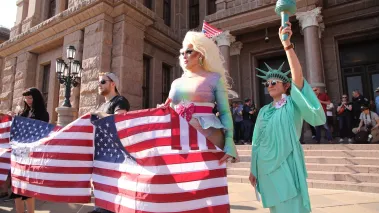
Drag shows are inherently expressive and protected under the First Amendment. That’s what a panel of the U.S. Court of Appeals for the Fifth Circuit held back in August, reversing a district court’s decision that had upheld West Texas A&M University’s campus-wide drag show ban.
Yet several weeks later, the Fifth Circuit elected to vacate the panel’s decision and rehear the case en banc, meaning the full Court will consider whether the First Amendment permits government officials to ban a drag show because they disagree with the show’s message. As FIRE fights to preserve the panel’s decision upholding the right of public university students to engage in expressive conduct, a broad coalition of free speech advocates has rallied to file “friend of the court” briefs in support.
Here’s what happened: West Texas A&M University maintains Legacy Hall as an open forum for students and the public to interact and engage in expression. FIRE’s client in this case is Spectrum WT, a long-recognized student organization that seeks to provide support for and promote acceptance of the LGBTQ+ student body. To that end, Spectrum WT hosts a wide range of campus events, both social and educational, to raise awareness of issues important to LGBTQ+ students and foster a strong sense of community and acceptance.
The Constitution prohibits University officials from censoring student expression on campus because they happen to disagree with its underlying message.
Several years ago, Spectrum WT began planning a charity drag performance to be held at Legacy Hall. Proceeds from the event would benefit the Trevor Project, an organization dedicated to suicide prevention in the LGBTQ+ community.
But eleven days before the performance’s scheduled date, the university’s President, Walter Wendler, canceled the event. In a lengthy public statement, Wendler announced that “West Texas A&M will not host a drag show on campus,” even while conceding that drag performance is “artistic expression” and that “the law of the land” requires him to let the show go on. According to Wendler, he opposes drag’s underlying “ideology,” believing it “demeans” women and that there is “no such thing” as a “harmless drag show.”

West Texas A&M President cancels student charity drag show for second time
West Texas A&M President Wendler enforced his unconstitutional prior restraint by canceling a student-organized charity drag show for the second time.
That’s when FIRE stepped in. Our country’s universities are bastions of free expression, exploration, and self-discovery. They are uniquely places where young adults may have their opinions tested and viewpoints expanded. And the Constitution prohibits university officials from censoring student expression on campus because they happen to disagree with its underlying message.
That was what the Fifth Circuit panel held when it heard this case on appeal. Yet several weeks later, the court decided to vacate the panel’s decision and consider the case a second time. So the fight to preserve First Amendment protections for students’ artistic performance, regardless of whether university officials agree with the message, continues.
Last week, a bipartisan coalition of university professors, prominent legal scholars, and no fewer than thirteen organizations filed five amicus briefs in support of Spectrum WT:
- The ACLU of Texas and Equality Texas highlight the district court’s doctrinal errors in upholding Wendler’s blanket drag ban, including the court’s failure to recognize the message, history, and context of drag performance and its reliance on a standard for protected expression the Supreme Court has explicitly rejected. As the ACLU of Texas and Equality Texas explain: “The district court’s narrowing of the First Amendment’s protective scope sets an alarming precedent, which, if left uncorrected, could extend beyond the drag performance at issue in this case.”
- The First Amendment Lawyers Association argues that the lower court’s decision violates the “bedrock First Amendment principle” that government officials may not censor speech merely because they dislike the message. They emphasize how this violation is even more egregious in the university setting, “where speech rights are particularly important.” As FALA describes, Wendler “suppressed protected speech, impoverished public discourse, and denied students and the broader community the right to engage, critique, and learn in a free marketplace of ideas.”
- The National Coalition Against Censorship, Dramatists Guild of America, Comic Book Legal Defense Fund, Fashion Law Institute, Authors Guild, Woodhull Freedom Foundation, Freedom to Read Foundation, American Booksellers Association, and Americans United for Separation of Church and State emphasize the evidence establishing that Wendler’s blanket prohibition was inherently a viewpoint-based prior restraint that finds no support in First Amendment law. They argue that Wendler’s prohibition is, in fact, “a ‘classic’ example of a prior restraint” that is “unmoored from any objective standards” constraining his censorship authority. As they explain, such prior restraints are unconstitutional as reflected in the “text, history, and tradition of the First Amendment.”
- The CATO Institute and renowned legal scholars Eugene Volokh and Dale Carpenter describe the applicable legal doctrine to explain why it ultimately does not matter whether Legacy Hall is classified as a limited public forum or nonpublic forum: because Wendler’s viewpoint discrimination is impermissible everywhere. They argue that drag performance is clearly protected expression under the First Amendment and that Wendler violated that protection by censoring drag performance because he disagrees with its message.
- A coalition of eight professors specializing in LGBTQ+ studies delve into the history of drag performance as artistic expression. They describe how drag has long existed as a medium to celebrate the LGBTQ+ community and defy gender norms and stereotypes. They argue that its message is unmistakable among the general public, and that Wendler’s sole motivation in censoring this artistic expression was his personal disagreement with that message.
Recent Articles
Get the latest free speech news and analysis from FIRE.

FIRE sues Bondi, Noem for censoring Facebook group and app reporting ICE activity
Deep dive into New York’s proposals to ban demonstrations near houses of worship

Iran replaced my mother’s voice with silence