Table of Contents
Rhetorical hyperbole: A powerful defense in defamation and true threat cases
Research & Learn
As the Supreme Court has explained, freedom of expression needs breathing space to survive and thrive. Exaggerated, hyperbolic rhetoric that does not convey actual statements of fact or represent anything close to a true threat deserves First Amendment protection.
By David L. Hudson, Jr., Associate Professor of Law at Belmont University
Consider the following scenario: The head of the local school board wields power with an autocratic hand, emphasizing the iron fist over the velvet glove. A critic of the board has finally had enough and publicly refers to the school board leader as “a Nazi” in an op-ed. The school board chair is gravely offended and responds with a defamation lawsuit, pointing out that he is not a Nazi and has never been associated with Nazism in any form.
Technically, calling the board chair a “Nazi” is a false statement of fact, but the critic contends that his speech was purely political and deserving of First Amendment protection. After all, a foundational First Amendment principle is the ability of people to criticize government officials, even intemperately or vehemently. The best defense for the critic is rhetorical hyperbole — exaggerated, over-the-top language designed for dramatic effect and emotional appeal rather than stating actual facts.
Rhetorical hyperbole remains a vital concept in First Amendment law, often ensuring necessary breathing space for individual expression that pushes the envelope, offends others, or challenges conventions. Rhetorical hyperbole can serve as an argument for defendants in two areas of First Amendment law: (1) defamation, and to a lesser extent, (2) true threats.
The idea behind the rhetorical hyperbole defense to the fact element of defamation is that readers know or should know that the over-top, exaggerated language is not to be taken literally and, thus, cannot harm someone’s reputation.
The language of the political arena, like the language used in labor disputes, is often vituperative, abusive, and inexact.
Real estate developer Charles Bresler learned the hard way the power of the rhetorical hyperbole defense. He sued a Maryland newspaper for defamation after it republished statements during a city council meeting, referring to Bresler’s negotiating positions with the city over a land deal as “blackmail.” Bresler asserted that the newspaper defamed him by falsely accusing him of a crime. A jury initially awarded him $5,000 in compensatory and $12,500 in punitive damages. However, on appeal the Supreme Court reversed and ruled for the newspaper in Greenbelt Co-op Publishing Association v. Bresler (1970), finding that “even the most careless reader must have perceived that the word was no more than rhetorical hyperbole, a vigorous epithet used by those who considered Bresler’s negotiating position extremely unreasonable.”
The rhetorical hyperbole defense resurfaced in another Supreme Court decision just a few years later in Letter Carriers v. Austin (1974). The case involved a union’s publication of a “List of Scabs”, pejoratively referring to non-union workers. Three such non-union workers sued for libel (written defamation) and prevailed — initially — in state court. However, the Supreme Court once again reversed the lower court’s ruling, finding that the use of the word “scab” was rhetorical hyperbole more than stating any actual factual assertions. The Court also noted that “exaggerated rhetoric” is common in labor disputes.
The rhetorical hyperbole defense also arises in the context of true threat cases. True threats, like defamation, are an unprotected category of speech — referring to expression that reasonably causes a listener to believe that the speaker has made a serious expression of an intent to cause serious bodily harm.
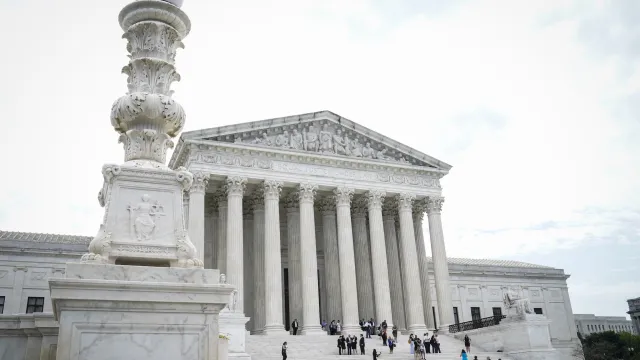
Supreme Court establishes higher standard for ‘true threat’ prosecutions
Thanks to the U.S. Supreme Court’s decision in Counterman v. Colorado, poorly worded jokes or exaggerations should no longer land someone behind bars.
The Court’s seminal true threat decision, Watts v. United States (1969), also involves rhetorical hyperbole. Robert Watts, a young 18-year-old African American, attended a Vietnam War protest in Washington, D.C. and stated:
They always holler at us to get an education. And now I have already received my draft classification as 1-A and I have got to report for my physical this Monday coming. I am not going. If they ever make me carry a rifle the first man I want to get in my sights is L.B.J. They are not going to make me kill my black brothers.
The initials “L.B.J.” were, of course, those of sitting President Lyndon Baines Johnson. This led the government to charge Watts with violating a federal law prohibiting making threats against the president. A jury found that Watts knowingly and willingly threatened the president, a conviction upheld by an intermediate appellate court. However, the Supreme Court reversed the decision, finding that Watts’ statements were a form of crude political hyperbole rather than an actual true threat. Thus, the prosecution failed to show that Watts had the requisite intent to harm the President.
“The language of the political arena, like the language used in labor disputes, is often vituperative, abusive, and inexact,” the Court wrote. “We agree with [Watts] that his only offense here was ‘a kind of very crude offensive method of stating a political opposition to the President.’”
Rhetorical hyperbole — or exaggerated, vituperative language that may offend or outrage — can be an important defense. As the Supreme Court has explained in different contexts, including the landmark libel decision of New York Times Co. v. Sullivan (1964), freedom of expression needs breathing space to survive and thrive. Oftentimes exaggerated, hyperbolic rhetoric does not convey actual statements of fact or represent anything close to a true threat. It deserves First Amendment protection.