Table of Contents
The Alex Pretti shooting and the growing strain on the First Amendment
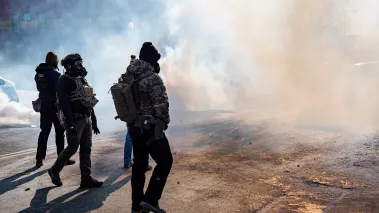
Shutterstock.com/Chad Davis
Minneapolis, MN — ICE and Border Patrol agents on Nicollet Avenue on Jan. 24, 2026, following the shooting death of Minneapolis resident Alex Pretti.
On Saturday, a 37-year-old intensive care nurse named Alex Pretti was shot and killed by United States Border Patrol agents in Minneapolis. The tragic loss of life, and the Trump administration’s response, deepen FIRE’s concerns about threats to the First Amendment rights to protest and to record law enforcement.
The killing demands a thorough and transparent investigation. Any agents who used lethal force without justification must be held accountable.
But Trump administration officials have shown little interest in waiting for that process to unfold. Instead, they have rushed to defend the shooting and lock in a narrative that portrays Pretti as someone who wanted to murder law enforcement. According to Kristi Noem, the secretary of homeland security, Pretti “arrived at the scene to inflict maximum damage on individuals and to kill law enforcement.” Border Patrol Commander at Large Greg Bovino made a similar statement at a press conference just hours after the incident, alleging that Pretti wanted to “massacre law enforcement.” On X, Stephen Miller, the president’s homeland security advisor, called Pretti a “domestic terrorist.” Administration officials continue to push this narrative, even as publicly available video raises serious questions about whether he posed a threat at all.
Officials have also said that the mere fact that Pretti was armed indicates he did not intend to remain peaceful, even though no evidence shows he used or brandished his lawfully owned firearm. On Saturday, Minneapolis Police Chief Brian O’Hara said that Pretti had a permit to carry a gun in public.
Whatever comes of the investigation, this moment demands a reaffirmation of basic First Amendment principles that the administration increasingly undermines by collapsing protected expression into criminal conduct.
First, Americans have a right to protest peacefully. That right doesn’t depend on the cause or politics involved. Whether you are protesting immigration enforcement, the president, abortion, or COVID-19 restrictions, you have a right to go outside and make your voice heard. But the administration has shown a pattern of hostility toward this nation’s long tradition of peaceful protest and dissent, including threatening demonstrators with “very heavy force” and targeting universities and foreign students over protest activity. In September, the administration released National Security Presidential Memorandum 7, which links disfavored viewpoints to domestic terrorism, notably “extremism on migration,” a term left undefined.
Second, Americans have a right to observe and record law enforcement officers performing their duties in public. Government officials sometimes abuse their power or make mistakes, and public observation and recording are essential tools for documenting misconduct and holding officials accountable. Nobody has a right to physically interfere with law enforcement. But officials have claimed — incorrectly — that it’s illegal to follow and videorecord federal agents or to share photos and videos of them online. Just last Friday in Maine, video revealed a masked ICE agent telling a woman recording him that he was taking pictures of her car because “we have a nice little database and now you’re considered a domestic terrorist.”
The administration’s invented or distorted definitions of “impeding,” “obstructing,” or “doxxing” have no basis in the law and are inconsistent with the First Amendment.
Third, Americans don’t forfeit First Amendment rights when exercising their Second Amendment rights. That was true when demonstrators opposing pandemic restrictions openly carried guns at the Michigan statehouse. And it’s true for those protesting immigration enforcement today. In some contexts, displaying the firearm itself is part of the expressive message. Threatening others with a firearm is plainly illegal, but legal carry cannot justify suppressing protected expression or using deadly force.
The drumbeat of statements from the administration that are openly hostile to basic First Amendment rights should disturb every American. And when Americans see someone shot dead in the street shortly after recording federal agents — and then hear top government officials immediately justify the shooting before any investigation can begin — they will reasonably fear that exercising these rights carries not just legal risk but physical danger.
Americans have the right to criticize our government. We have the right to come together in protest. We have the right to record law enforcement. When we exercise our First Amendment rights, we shouldn’t fear we will be detained, surveilled, added to government databases, assaulted, or worse.
As Supreme Court Justice Hugo Black said, free expression is “the best insurance against destruction of all freedom.”
Recent Articles
Get the latest free speech news and analysis from FIRE.
FIRE sues Bondi, Noem for censoring Facebook group and app reporting ICE activity
Deep dive into New York’s proposals to ban demonstrations near houses of worship
Iran replaced my mother’s voice with silence