Table of Contents
The campaign to crush free speech in Minnesota
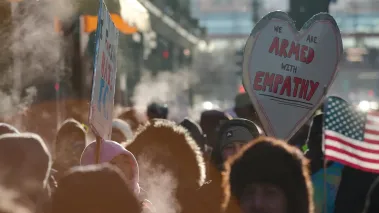
Jan. 23, 2026 – Protesters opposing ICE fill the streets of Minneapolis in subzero temperatures.
This essay was originally published in The Free Press on Jan. 21, 2026. Three days later, ICE agents shot and killed intensive care nurse Alex Pretti. See Aaron Terr’s analysis, “The Alex Pretti shooting and the growing strain on the First Amendment.”
Over the past two weeks, Minneapolis has given the country a crash course in the First Amendment.
The actions of protesters and politicians, during and in response to protests against Immigration and Customs Enforcement, have become real-world lessons in the law of speech. The clashes have demonstrated which types of speech aren’t protected, along with passionate, angry, and unsettling speech that is protected. We’ve also gotten a chilling reminder of what goes wrong when the government pretends not to know the difference.
For starters, the Justice Department has issued grand jury subpoenas to Minnesota Governor Tim Walz, Minneapolis Mayor Jacob Frey, and at least three other Democratic officials in the state, as part of an investigation into whether state and local officials obstructed federal immigration enforcement. Grand jury matters are secret, so we may never see the subpoenas themselves. But the public justification keeps circling back to speech. Federal officials have portrayed Walz’s and Frey’s criticisms of ICE as incitement, which is not protected by the First Amendment.
But by any reasonable assessment, the statements that have been publicly attributed to Walz do not meet the legal standard for incitement. The governor urged people to speak out “loudly, urgently, but also peacefully,” and warned them not to “fan the flames of chaos.” That doesn’t cross the constitutional line. Walz also used metaphorical political rhetoric, saying no governor should have to “fight a war against the federal government every single day” — language that has lived comfortably inside First Amendment protection for generations.
The speech that federal officials have criticized in Minnesota seems like protected political dissent, not obstruction or conspiracy.
Frey’s most quoted line — telling ICE to “get the fuck out of Minneapolis” — may strike some as crude and unstatesmanlike. But the f-bomb is not an actual bomb, and heated rhetoric like that is absolutely protected speech. Frey has also been accused of telling police to “fight ICE,” but at the same time he warned against a scenario in which federal and state authorities are “literally fighting one another,” and he urged de-escalation.
The First Amendment exists to deny the government the knee-jerk ability to decide which dissent is too dangerous, irritating, or inconvenient to tolerate during tense moments. We must not forget that, even when the content of others’ speech unnerves or infuriates us.
This is where the landmark 1969 Supreme Court case Brandenburg v. Ohio comes in. By the standard set in that case, advocacy is protected unless it’s “directed to inciting or producing imminent lawless action and is likely to incite or produce such action.”
That standard exists for a reason. Governments are always tempted to blame words for violence they can’t control. If “heated rhetoric” were enough, dissent would disappear whenever officials felt threatened — which, of course, would end up being all the time.
The speech that federal officials have criticized in Minnesota seems like protected political dissent, not obstruction or conspiracy. That raises the discouraging possibility that the point of the Justice investigation isn’t to bring charges that will stick. Rather, it may be to use the threat of prosecution to chill speech.
That’s not law enforcement. It’s ideology enforcement, backed by mob-like bully tactics.

In defense of fiery words
In the wake of political violence, calls to criminalize rhetoric are growing louder. But Brandenburg v. Ohio set the bar — and it’s a high one.
As for the protests themselves, some of what we’ve seen is textbook First Amendment activity: protesters chanting in public streets, filming law enforcement, warning neighbors of enforcement activity, criticizing policy. This is precisely the kind of free speech and free assembly the First Amendment was designed to protect.
Nevertheless, there is plenty of unprotected speech being improperly justified on First Amendment grounds. Since the start of ICE operations in Minnesota in November, we have seen objects thrown at officers, crowds pepper sprayed and tear-gassed, and worse. But the extent to which the First Amendment is implicated in interactions between protesters and ICE agents often depends on how the granular details played out, which isn’t always clear from the videos and testimonies.
U.S. district judge Katherine Menendez ruled last week that ICE agents can’t detain or use tear gas on peaceful observers who haven’t obstructed their operations. The 83-page ruling includes countless allegations from activists and ICE officers about each other’s conduct, many of which are egregious and some of which are factually incompatible with others.
Some types of speech, like crowds telling ICE agents to kill themselves in the heat of a protest, might strike most people as upsetting and offensive, but are still protected. While the White House has claimed that such incidents are the result of a campaign of targeted harassment against federal officers, it has so far not provided evidence to that effect. It seems just as probable that those protesters were motivated by their personal dislike of federal law enforcement and chose a harsh way to express it.
Some law enforcement activity violates the First Amendment even though it’s nonphysical. For example, there are credible reports that ICE agents have led civilian observers back to the observers’ homes. The message couldn’t be any clearer: ICE knows where you live. Assuming there’s no law enforcement reason to go to those homes, it’s a pure intimidation tactic designed to create a chilling effect, and the First Amendment is meant to protect us from that kind of retaliation for speaking out.
Minnesota isn’t showing that the First Amendment is obsolete. It’s showing that balancing its demands is difficult, and that getting it wrong is dangerous.
And then there’s the moment where the First Amendment lesson goes completely off the rails.
Across the river in St. Paul, protesters entered a church and disrupted a worship service. Journalist Don Lemon filmed the event, and while interviewing a member of the congregation, was told: “Our church had gathered for worship, which we do every Sunday. We asked them to leave and they obviously have not left.” The next thing we hear is Lemon saying, “So, this is what the First Amendment is about.”
No, it is not.
The First Amendment does not grant a right to commandeer private spaces or force unwilling audiences in a private space into a political confrontation. A church is not a public forum, and the actions of that group that day are not legally protected expression. They have a right to gather outside the church and protest on the sidewalk, but by walking into a private service and refusing to leave, they are, at a minimum, trespassing.
In this case, the protesters displayed a flawed understanding of protected speech. Believing your cause is morally urgent isn’t a valid defense for entering a private space unlawfully to deliver a message.
Put all these events and incidents together and the overall lesson becomes clear. Minnesota isn’t showing that the First Amendment is obsolete. It’s showing that balancing its demands is difficult, and that getting it wrong is dangerous.
Speech is not violence. Protest is not conspiracy. Criticism is not incitement. Violence is not speech. And disruption of private spaces is not protest. When we blur those lines, we don’t advance justice; we empower whoever currently has the authority to determine what those words mean. The First Amendment exists to deny the government the knee-jerk ability to decide which dissent is too dangerous, irritating, or inconvenient to tolerate during tense moments.
We must not forget that, even when the content of others’ speech unnerves or infuriates us.
Recent Articles
Get the latest free speech news and analysis from FIRE.
FIRE sues Bondi, Noem for censoring Facebook group and app reporting ICE activity
Deep dive into New York’s proposals to ban demonstrations near houses of worship

Iran replaced my mother’s voice with silence