Table of Contents
Duke shows what not to do when feds come knocking
Bryan Pollard / Shutterstock.com
This op-ed originally appeared in the Duke Chronicle on Dec. 21, 2025.
Duke’s fight against the Trump administration has a new front: employee speech. After the White House accused the school of maintaining unlawful racial preferences and cut millions of dollars in research funding as punishment, the University ordered its employees to keep silent.
In late August, Jenny Edmonds, Sanford School of Public Policy’s associate dean of communications and marketing, emailed faculty members that all requests about “Duke and current events” must go through the University’s PR office. She cited increased scrutiny on universities and their policies and admonished faculty to stay in their lanes, discussing only their research with the media. While Edmonds’s message was limited to the public policy school, faculty across the university got similar messages. President Vincent Price and Academic Council Chair Mark Anthony Neal praised the faculty, with Neal remarking it was “pretty amazing” that the Times received no comment from faculty members.
This kind of restriction is offensive to free speech principles. Students and employees of private universities — that promise not suppress speech — have a right to speak with the media on matters of public concern. At public schools, those rights are protected by the First Amendment, but at Duke, it is the University’s own promises that enshrine employees’ rights to speak freely, without fear of university retaliation.
Restricting their expression not only hurts these community members’ speech rights but also the rights of other concerned citizens to listen to expert opinions about the institutions they know best. And imposing a restraint — even an implicit one — on what employees can say to the media makes Duke a liar, belying its posturing as a university committed to open discourse.
Suppressing student and employee speech instead of standing up for an institution's autonomy and legal rights will always be a losing battle.
Unfortunately, Duke isn’t alone in targeting speech to avoid political ire. Just ask student journalists at Purdue University, which broke off its longstanding agreement to distribute student newspaper The Exponent, citing a fear that others would conflate the paper’s positions with the university’s. Even though Purdue never cited the Trump administration’s campaign against higher education institutions, the insistence that honoring its agreement would constitute endorsing everything printed in a 135-year-old student newspaper suggests it, like Duke, wanted to make sure nothing its constituents said could draw unwanted government scrutiny.
And one can understand why Duke and Purdue felt pressure to censor their community members. There are countless examples of the Trump administration bringing the heat to universities, costing them hundreds of millions of dollars in funding. Outspoken students have even led federal officials to investigate — and pause funding for — major institutions.
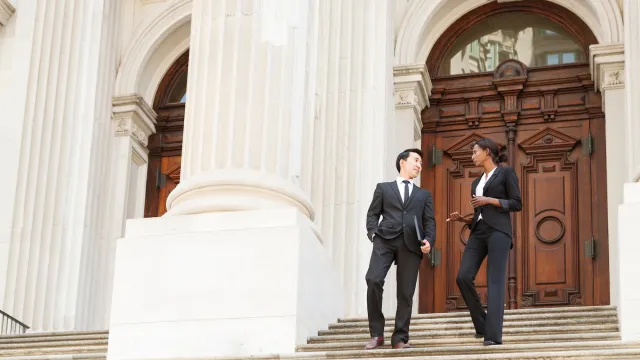
What free speech rights do government employees have?
Does the First Amendment protect public employees when they speak? It depends.
The fear that they could be next has not only chilled institutions; it’s led them to punish their own press corps and cut themselves off from other journalists. These responses, while noxious for a culture of free expression, may seem logical to administrators in the face of a government hellbent on attacking higher education. But even if such efforts seem like a good way to dodge pressure from Washington, universities are chilling speech that the Trump administration dislikes without the White House having to do anything.
But the Trump administration’s aggression can only explain so much. Some universities, like Harvard, have minced no words in rebuffing attacks on their institutional independence. Why not Duke? Purdue?
These universities are hurting their own case by targeting employees’ media comments. When they issue edicts restricting what employees can say, what this strongly suggests to an outside observer is that the university is in fact trying to hide something. It’s the higher-ed equivalent of Tony Soprano frantically stashing money in an air vent seconds before the FBI busts down his door.
Suppressing student and employee speech instead of standing up for an institution's autonomy and legal rights will always be a losing battle. Harvard knew that, and has enjoyed numerous court rulings affirming its First Amendment freedoms. Duke and its peers are facing jarring federal overreach, and one can understand their fear. But in choosing censorship over principle, they hurt their students, their faculty and themselves.
Recent Articles
Get the latest free speech news and analysis from FIRE.
TICKETS ON SALE: Step up to the Soapbox in Philadelphia, Nov. 4-6, 2026

LAWSUIT: FIRE sues Federal Trade Commission over agency’s targeting of news rating service
The secret war against student journalists