Table of Contents
The secret war against student journalists
Shutterstock.com
Filming student protesters. Emailing administrators about a newspaper launch. Asking a commentator for additional information to back up their claims. Placing a disclaimer on a letter to the editor. These basic journalistic practices are a far cry from disruption or harassment, yet student journalists nationwide have recently received notices of investigation based on each one of these acts.
These students face a fight behind the closed doors of conduct hearings, and the outcome of these battles determines how colleges and universities decide who is a journalist and what journalism on their campus can look like.
Since October, Ašiihkiokonci Parker has been under one such university investigation. A photographer and videographer for the independent student newspaper El Diario de la Gente, Parker covered a pro-Palestinian protest at a University of Colorado Boulder career fair on Oct. 16. Protesters stood in a circle, arms interlocked, while Parker filmed from outside the circle using a cellphone, capturing the protesters chanting, receiving instructions to disband from university officials, and eventually leaving.
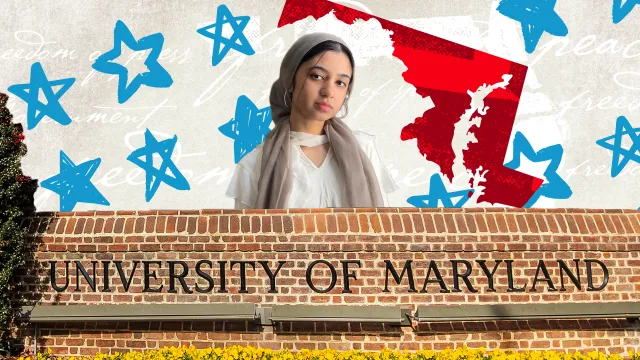
The paper was her lifeboat — UMD called it interference
She founded a Muslim student paper for community. Now UMD calls her reporting on a protest “interference” — and is pursuing discipline.
The next day, Parker received an email from CU Boulder’s Student Conduct & Conflict Resolution office. The email explained that Parker was under interim suspension and investigation for potential student conduct violations. The school based its preliminary decision on Parker swiping a student ID card to enter the career fair and film protesters. In other words — reporting on a newsworthy event.
Parker was suspended from campus for 10 days, but the suspension then became an “exclusion” allowing Parker to come on campus for classes only. CU Boulder lifted the interim disciplinary action on Nov. 7.
This means that for three weeks, a student journalist faced disciplinary action for their reporting — before official findings were ever made. That investigation lasted for three months, and eventually resolved in Parker’s favor.
Parker is not alone. Two student journalists for Al-Hikmah, an independent student newspaper “dedicated to informing and representing the Muslim community” at the University of Maryland, are facing student conduct charges including interfering with the expressive rights of others and engaging in disorderly and disruptive actions for recording disruptive protesters outside a Students Supporting Israel event on Oct. 23. The event featured Israel Defense Forces soldiers as guest speakers, sparking protest outside the building. Four protesters entered the building and began chanting right outside the event’s door as the two journalists, Riona Sheikh and Rumaysa Drissi, recorded the event and took pictures.
UMD alleged Sheikh and Drissi had “done more than merely cover, as journalists, other individuals’ protest” of the event. Rather, “it is alleged they were aware of and participated in such protest, albeit by recording and planning on reporting on it, rather than waving signs and shouting.”
What is local journalism if not reporting on events in one’s community? If simply recording events as they unfold can result in conduct charges, then this repackages routine newsgathering as a disruptive violation of school policy.
Instead of classifying student journalists as journalists, CU Boulder and UMD have grouped them in with the individuals they were covering. The result is campus newspapers that operate like leashed-in watchdogs — no longer the investigators, but the subject of investigation.
Parker, Sheikh, and Drissi all reported for independent student newspapers. Student journalists affiliated with independent outlets sometimes do not have the benefit of writing for more well-known outlets within their communities. That was the case for Alex Shieh, who alongside a dozen other students relaunched The Brown Spectator at Brown University last spring. On March 15, Shieh, inspired by the Department of Government Efficiency’s line of questioning about federal workers’ productivity, emailed over 3,800 Brown administrators for a Spectator story and asked them to explain what they had done the prior week.
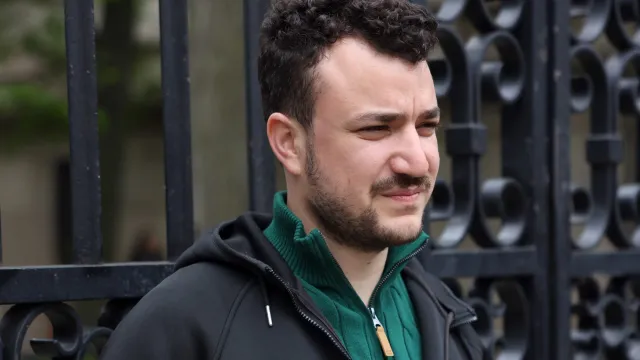
Unsealed documents prove the government crusade to deport Ozturk, Khalil, and others is based solely on protected expression
Unsealed documents show the government targeted pro-Palestinian students for deportation based solely on protected speech — not crimes.
Brown launched an investigation into Shieh on April 7 for potential conduct violations including invading privacy, misrepresentation, and inflicting emotional or physical harm. The university later traded those out for a trademark infringement charge against Shieh and the Spectator for use of the word “Brown” on May 2. On May 14, Brown found Shieh and the Spectator not responsible for any charges, though Shieh dropped out of college after the incident to launch a stealth startup.
While Shieh’s email and his subsequent reporting may have offended some on campus, editorial decisions that evoke offense shouldn’t lead to student conduct proceedings. Yet often they do, and not just at Brown.
Take the University of Texas at Dallas, which has clashed with student journalists since their critical coverage of the university’s response to pro-Palestinian encampments in May 2024. UT Dallas launched an investigation into former editor-in-chief of The Mercury Gregorio Olivares Gutierrez in August 2024, after a commentator who submitted a letter to the editor took issue with Olivares Gutierrez’s requests for additional sources and the placement of a disclaimer on his piece. Olivares Gutierrez and his editorial team received the editorial, which discussed antisemitism on campus, and though they wanted to publish it, they also noticed that some of the letter’s details didn’t line up with other reputable sources. Olivares Gutierrez and other editors asked the author to provide more sources, as their student handbook authorized them to do. When those concerns went unaddressed, Olivares Gutierrez and his team placed a factual disclaimer on the piece.
Those acts led to a yearlong investigation, in which UT Dallas characterized Olivares Gutierrez’s editing as “discriminatory harassment,” though, as editor, he never had to run the op-ed at all. Olivares Gutierrez is appealing the decision, which, if upheld, would place him under a two-year deferred suspension — meaning if he “messes up” again, Olivares Gutierrez will be automatically suspended.
Such outcomes are alarming, but even the investigations themselves pose major concerns, regardless of outcome. Investigations into student journalists for routine newsgathering and editorial functions are themselves a free speech concern, even if they don’t result in official sanctions. That’s because the threat of investigation is likely to discourage student journalists from engaging in these activities for fear of negative repercussions, casting a chill over the student press.
This trend of abusing student misconduct proceedings to silence student journalism sends a clear message about who gets to do journalism on campus: only those who toe the line administrators have in mind. Classifying student journalists as disruptors for reporting fearlessly on behalf of independent, lesser-known outlets on controversial subjects narrows an institution’s definition of who is a journalist on their campus. Are official student media outlets the only ones that can freely create student media by documenting controversial events on campus?
A similar question arises for what journalism can look like on these campuses: Is recording and planning on covering an event newsgathering or disruption? Is asking questions to administrators fact-finding or a violation of school policy? Is fact-checking and exercising editorial discretion journalism or harassment?
Colleges and universities are getting to decide the answers to those questions behind closed doors. And as they do, they’ll shape who gets to tell stories on their campuses and what stories get told.
Recent Articles
Get the latest free speech news and analysis from FIRE.
The Federal Bureau of Investigation (of protected speech)
The paper was her lifeboat — UMD called it interference
The federal charges against Don Lemon raise serious concerns for press freedom