Table of Contents
Online speech is powerful. That’s why Iran is silencing it.
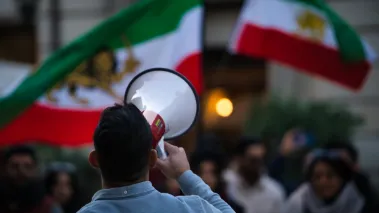
Shutterstock.com
Protest against the Iran regime in Turin, Italy, on Nov. 2, 2023.
This essay was originally published in The Washington Examiner on Jan. 14, 2026.
If the Islamic Republic of Iran has its way, the news you read and the social media you follow won’t show the truth of the shocking events happening right now within the country. A mass internet shutdown orchestrated by the government this month is threatening to silence expression from courageous Iranians, at least 12,000 of whom are now dead at the brutal hands of the state, who are fighting back against their oppressors.
Protesters took to the streets in late December 2025, furious over out-of-control inflation, empty shelves, and the country’s dire economic situation. Protesters’ outrage is not just limited to the economy, with widespread sentiment among demonstrators against the regime and its conduct more broadly. Some of the rhetoric echoes that from the 2022 protests against the theocratic government after the death of Mahsa Amini, arrested and then killed by police for violating the country’s mandatory religious dress code for women.
Though censorship on the part of the government has made an exact analysis of the breadth and turnout of the protests difficult, reports indicate these protests are massive — and spreading. Demonstrators took to the streets in every province, reportedly turning out in at least 185 cities.
Earlier in the protests, authorities promised a $7 monthly payment to residents in an attempt to paper over rising dissent. That effort failed. And the authorities’ tone — and behavior — has since swiftly grown more hostile.
Attorney General Mohammad Movahedi Azad warned that “charges against all rioters are the same,” regardless of whether they “are individuals who have helped rioters and terrorists in the destruction and damage of public security and property, or mercenaries who have taken up arms and caused fear and terror among citizens.” Judiciary chief Gholamhossein Mohseni-Ejei promised that the state’s response would be “decisive, maximum and without any legal leniency.” Supreme Leader Ayatollah Ali Khamenei has likewise made clear that he will not tolerate these challenges to his power, calling the movement terroristic and “mercenaries for foreigners.”
Punishment for detained protesters may ultimately include the death penalty. These are not idle threats. Iran shocked the global human rights community last year with its spike in executions. By September, authorities had already executed over 1,000 people in 2025.
Authorities’ ultimate aim is to limit what their subjects can say — and what the rest of the world can know about it.
And protesters are already paying the price. Authorities arrested at least 10,000 demonstrators, and thousands upon thousands have lost their lives. Doctors report a gruesome scene at hospitals from security forces “shooting from rooftops and terraces” rather than “on the street where people can see and run away.” In northern Iran, a morgue and hospital were so full that the “bodies were placed on top of one another.” And another horrific relic from the Mahsa Amini protests is resurfacing: hundreds of patients in Tehran “with pellets lodged in their eyes,” intentionally blinded by authorities.
But Iran isn’t just using brute force to escalate the crackdown on its people. It’s also deploying a repressive tactic that’s become increasingly common: suppression of the tools government critics use to broadcast their message on a mass scale. Authorities’ ultimate aim is to limit what their subjects can say — and what the rest of the world can know about it.
Starting on Jan. 8, the Iranian government enforced a suffocating internet blackout on the country, with a shocking 90% drop in traffic within 30 minutes after the ban began. These blackouts are a favorite tool of the regime; the government enacted blackouts in 2019 and 2022, too, to limit the spread of protesters’ words and also global attention on security forces’ violence against them. But experts warn this latest one represents a “new high-water mark” of online censorship in the country in its breadth and precision.
Iranian authorities have maintained their own internet access and ability to post on platforms such as X and Telegram while cutting off their people’s ability to do so. This suggests that the blackout is “more sweeping, but also appears to be more fine-tuned, which potentially means Tehran will be able to sustain it for longer.” In some places, authorities have even managed to inhibit access to Elon Musk’s Starlink system. Residents are experiencing a total cutoff of cellphone reception.
Authoritarians would not work this hard to silence you if they believed you were powerless. This is always the case with censorship.
Iran isn’t alone in using this tactic against its people. Last year marked the most severe year yet for internet shutdowns, with researchers tracking nearly 300 disruptions and blackouts in dozens of nations. India, Myanmar, Pakistan, and Russia stood among the worst offenders. “As internet access becomes consistently weaponized, restricted, and precarious, we are seeing pervasive patterns of crushing censorship and an urgent need for greater accountability,” Access Now cautioned.
If the early days of this year are any sign of what’s to come, 2026 may prove to be yet another repressive one. “This might be for the long haul,” Doug Madory, a researcher of internet blackouts, told the Guardian regarding Iran’s censorship. “I’ve been doing this for a while, and I think it’s going to be a big one.”
The killings, censorship, and shutdowns sweeping Iran are a tragedy and a warning bell. But they also signal a small spark of hope to the world’s oppressed: Authoritarians would not work this hard to silence you if they believed you were powerless. This is always the case with censorship. The more aggressively an authoritarian attempts to crack down, the more it advertises its weakness and its fear.
The responsibility now rests on the rest of the world to make sure we’re doing all we can to listen — and to fight for the future of a free internet. That future hangs in the balance, with new threats every day, from every sector.
Authoritarian regimes such as Iran, Russia, and China all exert varying degrees of vast power upon the internet, whether in outright blocks or technologically complex systems that place immense firewalls between their people and the rest of the world.
But even freer democracies are trying their hand at alarming and illiberal tech regulation, from Australia’s privacy-threatening and speech-chilling social media age-gating to the recent, and ripe for abuse, United Nations Cybercrime Treaty, and the United Kingdom’s byzantine Online Safety Act. Indeed, because the content itself depicts violence — which is simply the nature of what Iran’s people are suffering — the Online Safety Act may even hinder U.K. citizens, young and old alike, from accessing information on the internet about what’s happening in Tehran. Censorship does not make the British safer. It just makes them ill-informed.
Here in the United States, we are not immune from these threats either, from jawboning to unconstitutional state and federal legislation, which all too often receive support from across the political aisle. That has to change.
As we advocate a freer future for Iran’s protesters, we also need to protect on a global scale the tools they need to share their story with the rest of the world.
The future of freedom depends on the internet. We must start acting like it.
Recent Articles
Get the latest free speech news and analysis from FIRE.

Free speech in Trump 2.0
Podcast
The Federal Bureau of Investigation (of protected speech)

The paper was her lifeboat — UMD called it interference