Table of Contents
California prohibits its teachers from talking about a student's gender identity to their parents. That raises First Amendment concerns.
Shutterstock.com
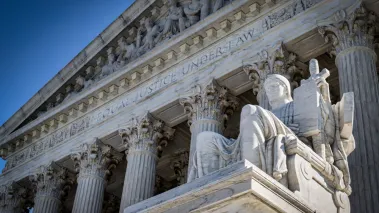
A summer day in front of the US Supreme Court Building in Washington, DC.
Can a state bar public school teachers from talking to a student’s parents about their minor child’s gender identity without the child’s consent? That’s the question presented by Mirabelli v. Bonta, an ongoing constitutional challenge to a California state policy that prohibits public schools from communicating with parents about their child’s in-school choices regarding their gender identity.
In Mirabelli, parents and teachers challenged California’s policy on a variety of constitutional grounds, alleging it violated the teachers’ First Amendment rights to free speech, the teachers’ and parents’ First Amendment right to the free exercise of religion, and the parents’ substantive due process rights under the Fourteenth Amendment.
In late December, a federal district court sided with the plaintiffs, issuing a permanent injunction against what it deemed the state’s “policy of secrecy when it comes to a student’s gender identification.” After California appealed, the United States Court of Appeals for the Ninth Circuit stayed the district court’s permanent injunction earlier this month. In turn, the plaintiffs filed for emergency relief from the Supreme Court of the United States, asking it to reinstate the injunction.
The district court and Ninth Circuit both focused primarily on the merits of the substantive due process and free exercise claims. Other courts considering similar questions have, too (and have reached varied conclusions). That focus is unsurprising, given the competing interests at play. The religious liberty group Becket argues in its amicus curiae brief to the Supreme Court, for example, that California’s policy interferes with parents’ right to direct the religious upbringing of their children, and therefore the right to free exercise should control the case’s outcome. But as the Court considers the plaintiffs’ request, it’s worth considering a few points about the free expression interests implicated by policies like California’s.
A government policy that bars public school teachers from communicating with parents about their children, particularly young children, warrants skepticism. Absent extraordinary circumstances — such as allegations of parental abuse — public schools shouldn’t keep important information about students from their parents. While class is in session, schools operate in loco parentis — in place of the parent. But that authority ends when the bell rings, and it cannot justify state-enforced silence.
Muzzling teachers presents problems, too. It’s true that public grade-school teachers are government employees. And when they speak in that capacity, their First Amendment rights generally take a back seat to the government’s interest in educating students. But as the district court correctly recognized, the government’s authority to control what public school teachers may say shouldn’t extend so far as to prevent them from delivering truthful information to parents about the students in their care.
Silencing teachers grants the government a dangerous degree of control over what parents know about what’s happening after students walk through the schoolhouse gate. Mandating information black-outs puts teachers in a difficult position; as the district court put it, “when a parent asks directly, the teachers are compelled to avoid answering.” It also sets a troubling precedent. Today, the ban is on gender information; tomorrow, it might bar talking about what K-12 students are (or aren’t) learning in class. And telling students that the government is a trusted keeper of secrets — especially secrets the government promises to keep from parents — teaches them a worrying lesson about the role of the state in our democratic society.
Recent Articles
Get the latest free speech news and analysis from FIRE.

The federal charges against Don Lemon raise serious concerns for press freedom
The American people fact-checked their government
Facing mass protests, Iran relies on familiar tools of state violence and internet blackouts